“Ta-ta-ta-tara, ta-ta-ta-tara…”
For many Japanese people, this familiar melody instantly brings back memories of Sunday evenings spent at home with family. It is the theme song of Sazae-san, Japan’s longest-running television animation and one of the country’s most beloved cultural icons.
The Sazae family lives together under one roof: grandparents, parents, children, and even the family cat, Tama. Three generations share everyday life, supporting one another through ordinary moments. For decades, this household has represented a nostalgic image of the traditional Japanese family.
Originally created by Machiko Hasegawa as a newspaper comic in 1946 before becoming a television series in 1969, Sazae-san has now been part of Japanese life for nearly 80 years. During that time, however, the way families live has changed dramatically.
Shift in Lifestyles: Seen Through Data
According to Japan’s 2024 Comprehensive Survey of Living Conditions published by the Ministry of Health, Labour and Welfare, one graph clearly illustrates this shift. Since nationwide statistics began in 1953, the number of households has steadily increased, while the average number of people living in each household has steadily declined.
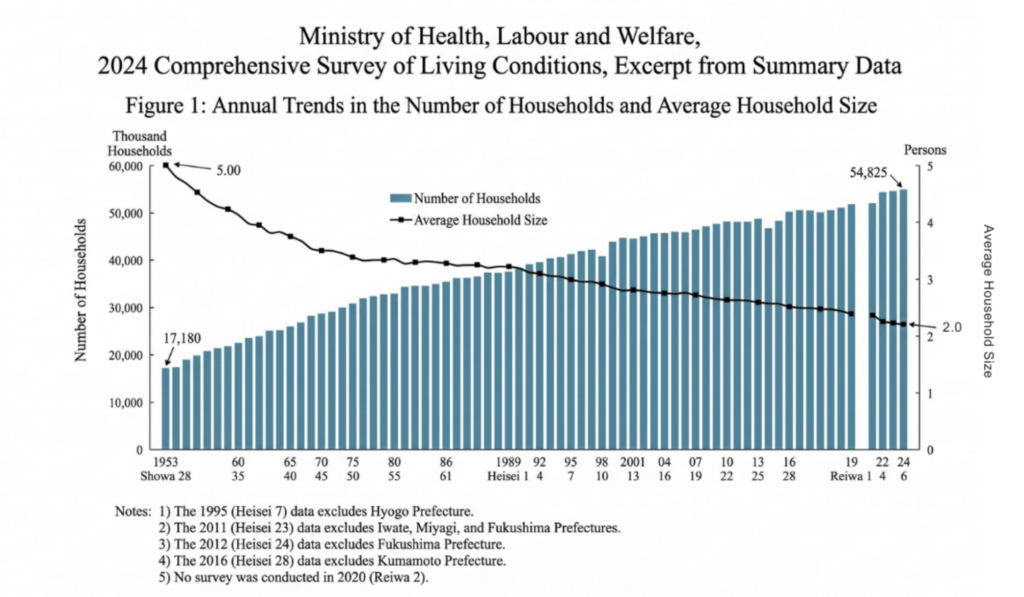
Source: Ministry of Health, Labour and Welfare, Comprehensive Survey of Living Conditions (2024)
Graph data reference (Japanese) :https://www.mhlw.go.jp/toukei/saikin/hw/k-tyosa/k-tyosa24/
In other words, more households are being formed, but each household contains fewer people than before.
Another government report helps explain what those households now look like.
The 2024 White Paper on Gender Equality published by Japan’s Cabinet Office reveals that, compared with 40 years ago, nearly half of all households now consist of either people living alone or single-parent families. Households centred around one person or one parent raising children have become far more common.
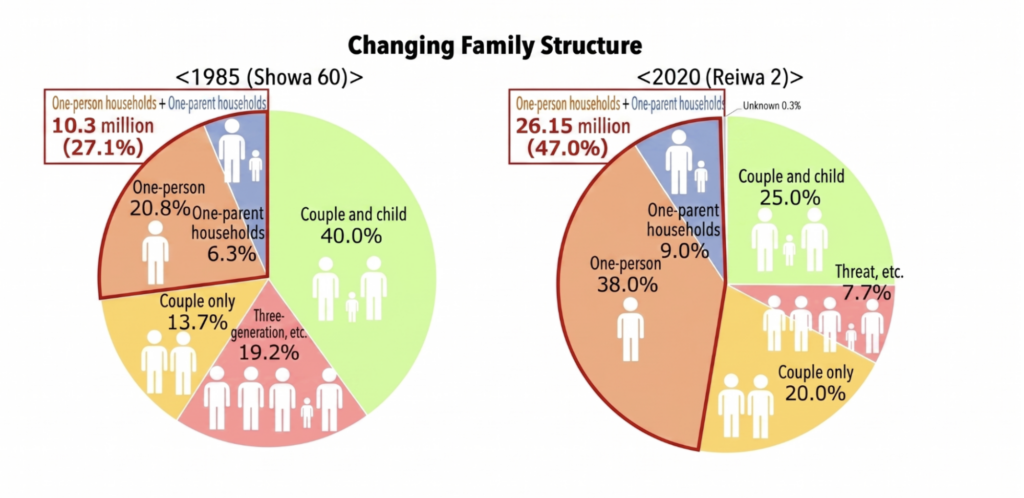
Graph data reference (Japanese): https://www.gender.go.jp/about_danjo/whitepaper/r06/zentai/pdfban.html
Why Young Generations Need ‘Safe Spaces’: Insights from Wellbeing Data
We would also like to share some findings about younger generations.
Earlier this year, Japan’s Children and Families Agency released the results of a nationwide survey of approximately 20,000 people between the ages of 10 and 39. The study explored young people’s wellbeing, asking how they view life, how they relate to others, how they cope with difficulties, and where they seek support.
Data set is found here (Japanese):https://www.cfa.go.jp/resources/research/kowaka/results
Among the 59.5% of respondents who said they had experienced significant difficulties in their daily or social lives, researchers asked those who had successfully overcome those challenges what had helped them recover.
The three most common answers were:
- Support from family or relatives: 56.1%
- Support from friends: 41.7%
- Simply allowing time for circumstances to change: 40.4%
Some respondents also found help through other avenues:
- Talking with someone who had experienced similar difficulties: 7.3%
- Visiting a counselling service: 6.8%
- Consulting school counsellors or other educational professionals: 4.5%
- Using online or email counselling services: 3.6%
- Using generative AI services: 3.4%
- Support from local community members: 1.1%
- Telephone counselling services: 0.6%
Of course, support from family and close friends remains invaluable. But as households become smaller and more people live alone, having other places and people to turn to may help many more individuals navigate life’s challenges.
Finally, one of the most fascinating findings from the survey explored the relationship between life satisfaction and the number of places where people feel safe and comfortable. The researchers defined these “safe places” as one’s own room, home, school, workplace, local community, and online spaces. The results were striking.
Percentage of people reporting high life satisfaction
- 0 safe places: 17.4%
- 1 safe place: 29.0%
- 2 safe places: 38.2%
- 3 safe places: 51.1%
- 4 safe places: 61.4%
- 5 safe places: 71.9%
- 6 safe places: 76.1%
The trend is remarkably clear. As the number of places where people feel they truly belong increases, so does their overall happiness.
For those who may feel isolated at home or under pressure at school or work, having a “third place”, somewhere beyond family and the workplace where they feel accepted, can make a meaningful difference to their wellbeing.
As society evolves, so too do our lifestyles and family structures. Compared with the era represented by Sazae-san, many of us may now have fewer people around us in our everyday lives.
Yet these findings remind us of something hopeful.
Simply having one more place where we feel safe, welcomed, and connected can greatly enrich our daily lives. Building relationships within our communities and creating spaces where people can comfortably support one another may be one of the keys to living happier, more fulfilling lives.
At NAMOW, this belief inspired My Choice Terakoya.
Our hope is to reimagine the warm, supportive human connections that once existed naturally within local communities, and to create a modern version suited to today’s world. Through beauty and wellness, we strive to build a society where everyone has the opportunity to live authentically and shine in their own way.
In our next article, we will explore the history of Terakoya, the community learning spaces that flourished during Japan’s Edo period. Far more than simple schools, Terakoya served as places where local communities nurtured and supported children.
By looking back at this remarkable tradition, we hope to share the inspiration behind NAMOW’s My Choice Terakoya initiative and the vision that continues to guide it today.
▶︎▶︎ This blog is published as part of the My Choice Project.
What is NAMOW’s “My Choice”?
“My Choice” is an initiative by NAMOW Co., Ltd. dedicated to enhancing mind and body well-being. To help everyone shine in their own unique way, we provide insightful content, host campaigns, and offer “My Choice Terakoya”—a welcoming space designed to broaden your everyday choices through meaningful learning and self-discovery.